Niacinamide and Immortelle: How to Combine Niacinamide With Nina Natural Skincare
One question comes up almost every week: “I use a niacinamide serum, and your Serum contains vitamin C. Can I use them together?”
The short answer: yes. Niacinamide is compatible with all Nina Natural products, including our Serum containing vitamin C. The idea that active ingredients cannot be used with our skincare is a misconception. A good foundational skincare routine is exactly what helps an active ingredient deliver results.
What Is Niacinamide, and Why Is Everyone Using It?
Niacinamide is a form of vitamin B3. It is popular because it does several things at once:
- Strengthens the skin’s protective layer, known as the skin barrier, helping the skin retain moisture.
- Calms redness.
- Evens out skin tone.
- Is well tolerated by the skin, which is why people with sensitive skin use it, too.
We explain why a healthy skin barrier is the foundation of every skincare routine in our article Skin Barrier First.
“Niacinamide and Vitamin C Don’t Mix”: Where Did This Idea Come From?
This is probably the best-known myth in facial skincare.
The idea comes from older laboratory experiments in which pure substances were mixed in a test tube. That does not reflect how you apply skincare. Your products are finished, stable formulations that you apply to your skin one after another.
That is why you can use niacinamide and vitamin C in the same routine.
If your skin does sting, the cause is usually a high-strength niacinamide serum or too many active products used at once, rather than a “reaction” between the two ingredients. Our Serum contains a small amount of vitamin C as part of its nourishing formula, so stinging is unlikely when using it.
How Can You Fit Niacinamide Into a Nina Natural Skincare Routine?
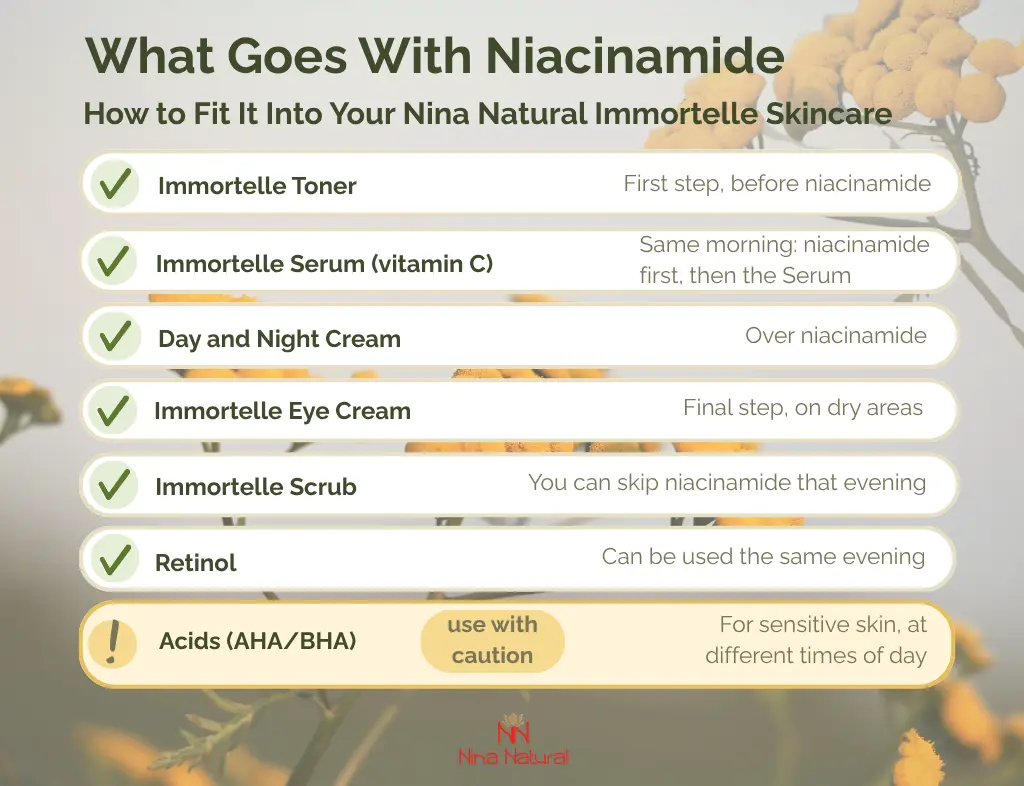
The basic rule: apply lightweight, water-based products first, followed by thicker and oil-based products. Niacinamide serums are usually water-based, so they go on before our serum and creams.
In the Morning
- Wash your face.
- Apply Immortelle Toner.
- Apply your niacinamide serum.
- Apply Immortelle Serum.
- Immortelle Day Face Cream
- Apply sunscreen (Nina Natural Day Cream does not contain SPF, so do not skip this step).
In the Evening
- Wash your face.
- Apply Immortelle Toner.
- Apply your niacinamide serum.
- Apply Immortelle Night Cream.
- Apply Immortelle Eye Cream to areas with fine lines.
On evenings when you use Immortelle Scrub, it is better to skip niacinamide because your skin is more sensitive at that point, as it typically is after physical exfoliation.
If Your Skin Stings or Becomes Red
- You do not need a serum with a high percentage of niacinamide. A higher concentration does not mean better results, and irritation is more common. Start with a serum that contains a lower percentage of this active ingredient.
- Start slowly: apply your niacinamide serum every second or third day at first. Once your skin adjusts, you can use it more often.
- Use niacinamide only in the evening, and Immortelle Serum in the morning.
- Take a break for a few days and use only the Toner and Eye Balm, which are fragrance-free.
If you use other active ingredients alongside niacinamide, see how to work them into your routine with retinol, acids, and peptides.
When Should You Consult a Dermatologist or Esthetician First?
Niacinamide is one of the gentlest active ingredients, and most women can introduce it into their routines on their own. Still, in some cases, it is better to seek advice from a dermatologist or an esthetician who knows your skin before trying your first niacinamide serum:
- If you have rosacea, eczema, or very sensitive skin that reacts to most products.
- If you are using a skin treatment prescribed by a doctor.
If you have started using niacinamide and the redness or stinging does not go away even after taking a break for several days, contact a dermatologist.
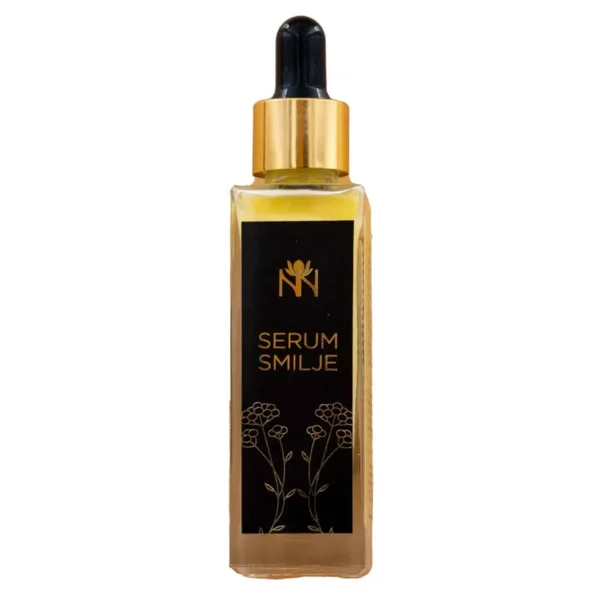
Face, Neck, and Décolletage Helichrysum Skin Serum
- A rich blend of immortelle extract and plant oils, including almond, apricot kernel, olive, sunflower, calendula, grape seed, and wheat germ oils
- Contains vitamin C, vitamin E, and sodium hyaluronate, a form of hyaluronic acid
- Enriched with aloe vera for additional skin care
- Nourishes and softens the skin, helping it maintain a smooth, supple, and well-cared-for appearance
- Specially formulated for the face, neck, and décolletage, including skin that feels dry, less supple, or in need of extra nourishment
- Handmade in small batches
- 30 ml, glass packaging
Frequently Asked Questions
In What Order Should I Apply Retinol and Niacinamide if I Use Them on the Same Evening?
Apply retinol to a dry face and wait about 10 minutes for it to absorb. Then apply your niacinamide serum, followed by Immortelle Night Cream. If your skin is sensitive, you can also use them on different evenings. Read more in our article on how to combine retinol with immortelle skincare.
How Should I Combine Niacinamide and Acids?
The simplest approach is to use the acid in the evening and niacinamide in the morning. That way, your skin is not exposed to two active ingredients at once. We explain how to plan a full week of skincare incorporating acids in our article on AHA and BHA acids and immortelle.
What Percentage of Niacinamide Should I Choose?
Serums containing up to 5% niacinamide are sufficient to start with. Higher-strength serums do not necessarily deliver better results and are more likely to cause redness and stinging. If your skin responds well, there is no need to switch to a stronger serum.
When Will I See the First Results After Starting Niacinamide?
Niacinamide does not work overnight. The first changes usually appear after a few weeks of regular use, with more noticeable results after two to three months. So do not give up after the first two weeks.
Allergen note: Nina Natural products contain ingredients that some people may be sensitive to: almond oil, wheat germ oil, lanolin, beeswax, calendula, immortelle, fragrance (Day Cream and Scrub), and lavandin essential oil (Night Cream). Always test each new product on a small area of skin first.
This article is for informational purposes only and does not constitute medical advice. If you have questions about your skin, consult a doctor or dermatologist.